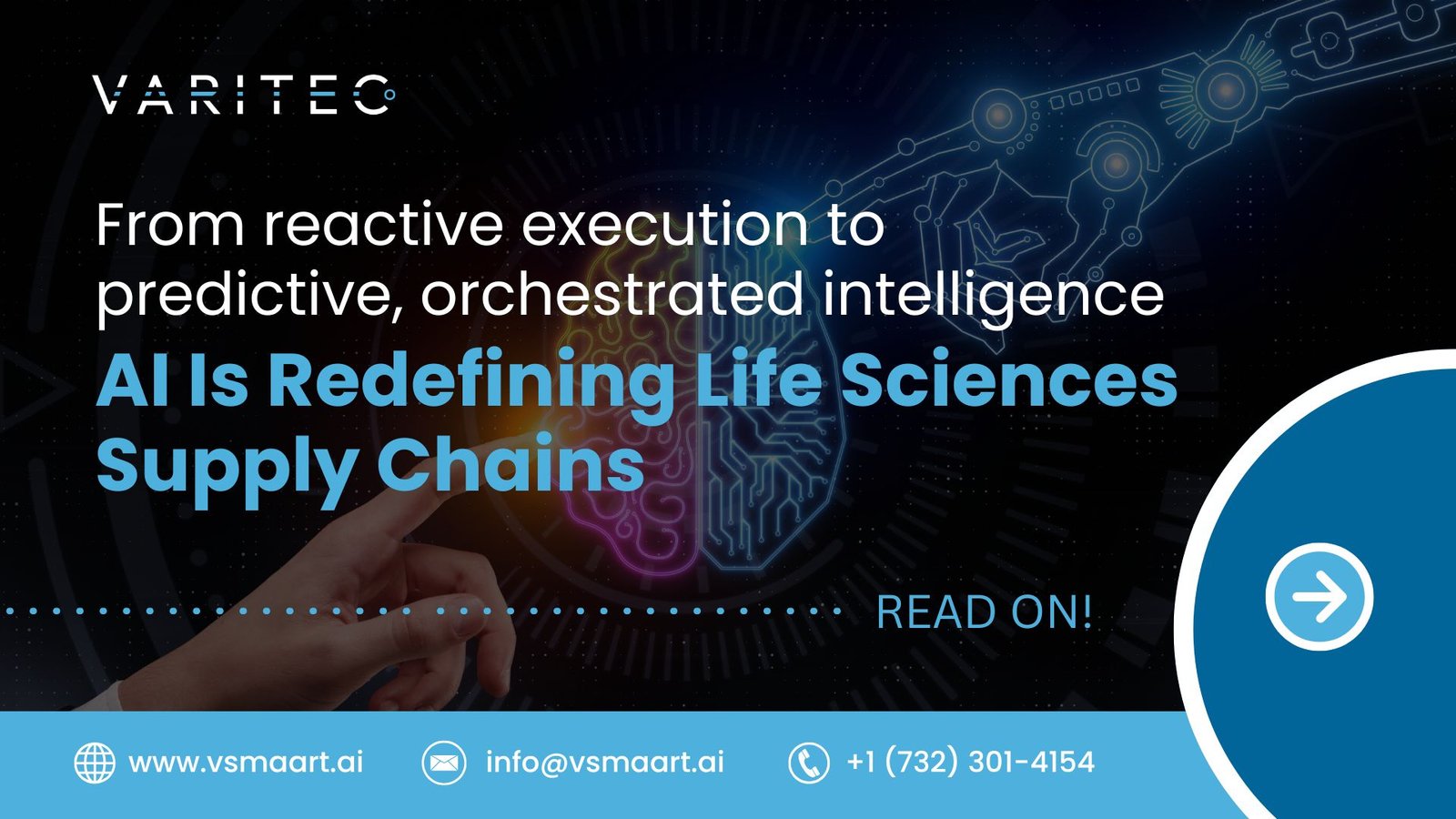
AI-Driven Innovation in Life Sciences Supply Chains
How AI, Orchestration, and Predictive Intelligence Are Reshaping the Future
In today’s life sciences environment, supply chains have evolved from operational support functions into strategic engines that directly influence patient access, regulatory confidence, and enterprise competitiveness. Traditional approaches focused on compliance and cost control are giving way to AI-driven orchestration, predictive intelligence, and real-time responsiveness. For C-Suite leaders, the implications are profound: strategic adoption of AI is now essential to sustain growth, manage risk, and secure global supply continuity.
Why AI Matters Now?
According to the LogiPharma AI Report, more than 51% of life sciences supply chain leaders expect measurable ROI from AI/ML investments within 2–3 years, with a focus on inventory optimization and visibility enhancement. These insights confirm what leading innovators have known for some time: AI is not a futuristic experiment – it’s a practical tool fueling outcomes today.
But what does AI actually deliver in life sciences supply chains?
1. From Reactive to Predictive & Prescriptive
Pharma supply chains have historically been reactive, responding to delays, demand spikes, and compliance bottlenecks after they occur. AI changes that. AI-powered predictive analytics learn patterns from internal and external data sources – inventory levels, transportation status, demand signals, supplier behavior, weather patterns, economic indicators, and even regulatory changes, to forecast future outcomes with greater accuracy than traditional statistical models.
For example, TraceLink’s Product Availability Intelligence tool uses billions of data points across its life sciences network to predict potential drug shortages up to 90 days before traditional methods, with more than 80% accuracy. This early warning capability is not just a competitive advantage; it protects patient health, brand reputation, and market share.
This shift from reactive to predictive and prescriptive workflows underpins smarter inventory and manufacturing planning, improved demand fulfillment, and reduced compliance risk.
2. AI-Powered Orchestration: The New Control Layer
Orchestration goes beyond automation. It represents a connected operating model where people, processes, and systems behave as a single, adaptive network. At life sciences conferences such as LogiPharma 2025, orchestration intelligence, integrating data flows across enterprise ERP, manufacturing execution systems, partner networks, and logistics partners, emerged as a key differentiator.
Rather than reacting to isolated alerts or departmental workflows, AI-enabled orchestration:
- Aligns supply, quality, manufacturing, and compliance functions in real time
- Detects deviations early and automatically prioritizes responses
- Bridges internal systems with external partners for dynamic collaboration
This “living supply chain” approach transforms static execution into a responsive system capable of adaptive decision-making and self-healing operations – a stark contrast to legacy batch processing and siloed reporting.
3. Multi-Enterprise Real-Time Intelligence
AI’s value amplifies when it integrates across extended supply networks, not just individual silos. Life sciences supply chains consist of manufacturers, contract manufacturers (CMOs), logistics providers (3PLs), distributors, and regulatory bodies – all generating streams of operational data.
AI tools that synthesize multi-enterprise data provide a 360° view of every transaction, deviation, and demand shift. One striking example is the use of real-time analytics and digital tracking to enhance tracking, tracing, and compliance visibility – leading to stronger regulatory alignment and faster response to disruptions. This cross-enterprise intelligence enables:
- End-to-end visibility with no blind spots
- Collaborative forecasting and shared planning
- Automated exception handling across partners
- Faster root-cause resolution without manual intervention
4. Risk Management & Resilience Built In
At the core of AI-driven supply chain innovation is resilience – the capacity to sense, respond, and adapt. Traditional systems depend on human intervention long after the damage is already done. In contrast, AI models continuously analyze deviations and predict operational risk, enabling executives to anticipate issues before they escalate.
From cold chain logistics vulnerability to customs clearance delays, life sciences companies are embedding predictive signals into orchestration layers so that risk mitigation becomes proactive, not reactive.
5. Driving Digital Workforce & Efficiency Gains
A common myth about AI is that it replaces people; in reality, it empowers people to focus on strategic work by automating repetitive, data-intensive tasks such as anomaly detection, routine reporting, and compliance checks. AI also accelerates cycle times (e.g., demand planning, inventory adjustments) and enables operational excellence through decision support – not just decision automation.
Gartner predicts that by 2028, GenAI models will power 25% of KPI reporting in supply chain functions, reinforcing how analytics and insights – rather than raw data, will drive organizational performance.
6. Implementing AI: Challenges & Best Practices
Despite widespread interest, adoption isn’t without challenges:
- Data silos and inconsistent formats
- Legacy systems that resist integration
- Regulatory compliance constraints
- Workforce skill gaps
To unlock value, organizations need to:
- Start with clean, connected data architectures
- Layer AI within orchestration workflows – not in isolation
- Invest in middleware and integration platforms to unify fragmented systems
- Create change management programs that upskill supply chain teams
The journey from AI curiosity to AI maturity requires a strategic roadmap and a foundation of data trust.
7. The Competitive Edge : Why This Matters Today
AI in life sciences supply chains is more than a futuristic trend – it’s a commercial necessity. Those who lag in adoption risk slower response times, higher costs, and reduced regulatory control. Those who lead are:
- Delivering medicines faster and more reliably
- Minimizing stockouts and waste
- Reducing compliance risk with audit-ready data
- Enhancing partner collaboration across extended networks
Today’s leaders are not just digitizing processes – they are reimagining supply chains as adaptive, learning systems powered by AI.
Conclusion: Reimagine the Connected Supply Chain
AI-driven innovation is transforming life sciences supply chains from fragmented, static ecosystems into dynamic, predictive, and orchestrated networks. For senior leaders, this is the moment to accelerate adoption – integrating AI into the very fabric of supply chain operations and governance. The future belongs to those who harness real-time intelligence, collaboration, and strategic automation to deliver value at every step, from manufacturer floor to patient care.
How VariTec Consulting Can Help
At VariTec Consulting, we help life sciences organizations turn AI ambition into operational reality. Our deep expertise across supply chain application management, ERP–EDI integration, compliance systems, and middleware orchestration enables pharma enterprises to move from fragmented execution to intelligent, connected supply chains.
Whether you are looking to:
- Unify ERP, EDI, serialization, and partner systems
- Enable AI-driven visibility and predictive insights
- Strengthen compliance while accelerating speed and scalability
- Build resilient, future-ready supply chain operations
VariTec Consulting partners with you at every stage – from strategy and architecture to implementation and continuous optimization.
Connect with VariTec Consulting to explore how AI-driven orchestration and intelligent supply chain platforms can help your organization operate smarter, faster, and with confidence.
Let’s build a connected, intelligent supply chain – together.
References
- LogiPharma AI Report 2025 — Supply chain leaders expect ROI from AI/ML investments.
- TraceLink Product Availability Intelligence wins predictive analytics award; predicts drug shortages up to 90 days in advance.
- AI tools promise better tracking and tracing in life sciences supply chains.
- Shift toward orchestration intelligence at LogiPharma 2025.
- Adoption moving from reactive to predictive in pharma supply chains.
- Gartner on supply chain AI transformation and GenAI KPI impacts.